





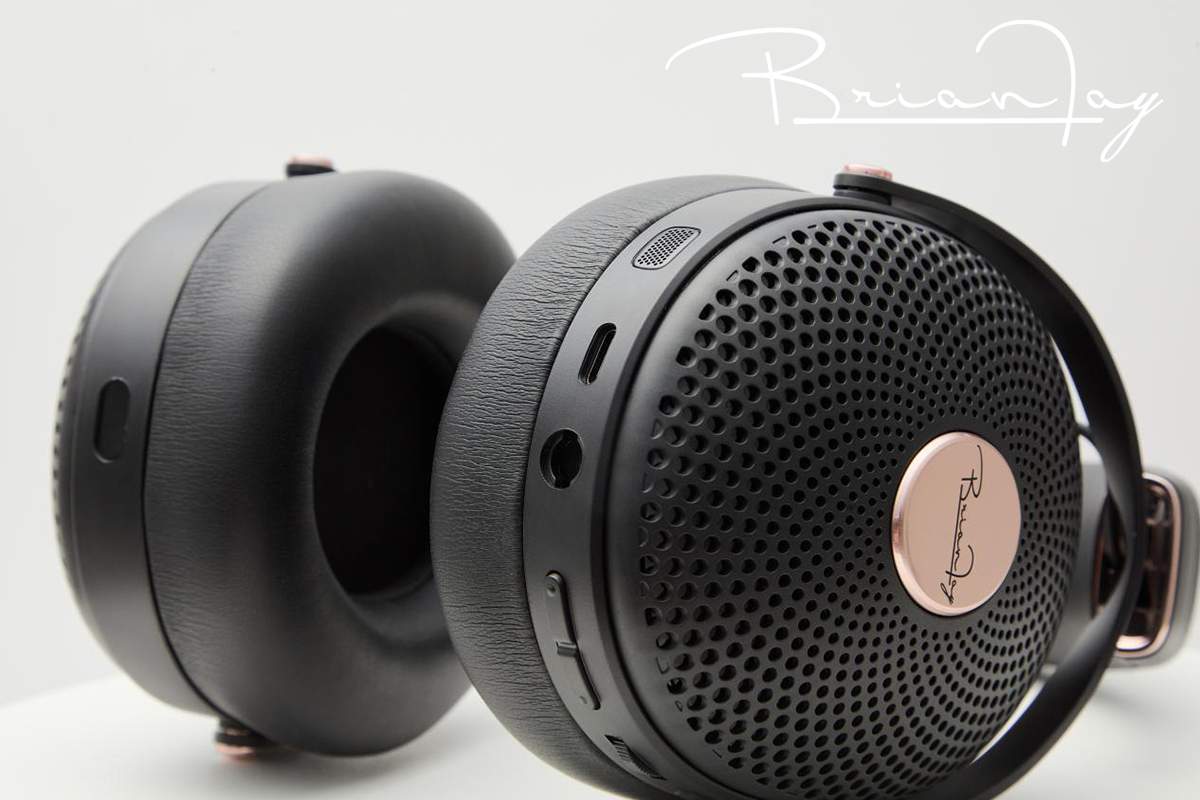
In the studio, there are always moments that feel restrictive—like when your headphone cable snags on a keyboard stand or tugs at the jack while you’re recording a synth part. Usually, you face a choice: put up with the cable’s pull, or switch to wireless headphones and accept the latency inherent in Bluetooth. Clearly, neither option is ideal.
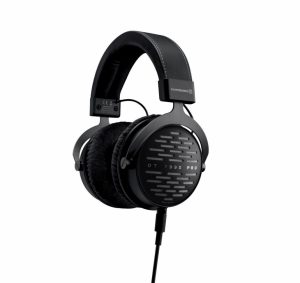
BrianFay’s Poly50 and Para50 are two over-ear headphones that share the same physical design but differ in configuration and purpose. Visually, they are identical—down to the finest detail—to the point where I had to mark them during testing to avoid mixing them up.
The Poly50 is designed for professional instrument monitoring; it comes with a dedicated 5.8GHz transmitter, offers latency as low as 5.6 milliseconds, and is priced at approximately $160. The BrianFay Para50 is a standard Bluetooth model supporting Bluetooth 5.4, priced at around $100.
In terms of performance, the Poly50 utilizes a dual-band wireless audio system (2.4GHz for Bluetooth and 5.8GHz for instrument connections), whereas the Para50 supports only the 2.4GHz band. Both models incorporate full-duplex audio transmission technology and proprietary anti-interference algorithms to ensure stable signal transmission and prevent interference. Additionally, through all-digital IR sampling algorithms and high-bandwidth transmission, both headphones deliver high-fidelity audio quality approaching that of a wired connection, offering excellent detail reproduction with no perceptible audio loss.
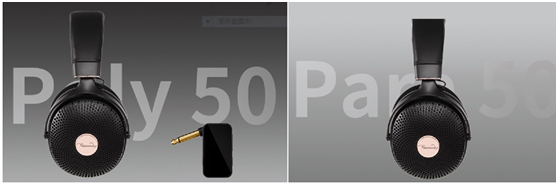
Build Quality: Practical, Not Luxurious
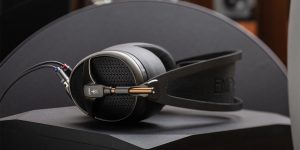
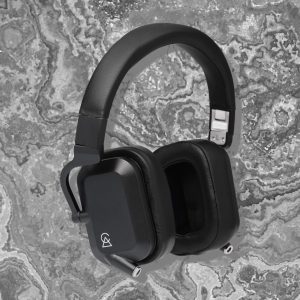
The headband design follows a conventional, accessible style and is quite substantial; the core structure combines foam and spring steel, wrapped in soft, smooth-feeling leather with meticulous craftsmanship. The curved arms supporting the ear cups are made of 1mm-thick steel—the only visible metal components in the structure. The overall build feels solid, and the joints move flexibly and smoothly.
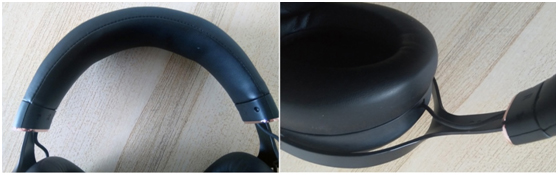
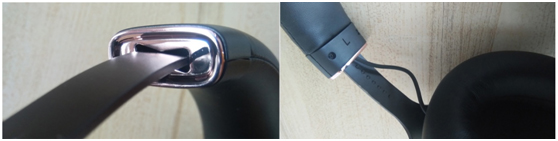
The ear cups connect to the extendable headband via a design featuring guide slots. One detail caught my eye: the cable connecting the ear cup unit to the headband is exposed. This is an uncommon design choice, and I was initially concerned about durability. However, after a week of use, the cable shows no signs of damage. While the aesthetic isn’t exactly refined, the design certainly looks practical.
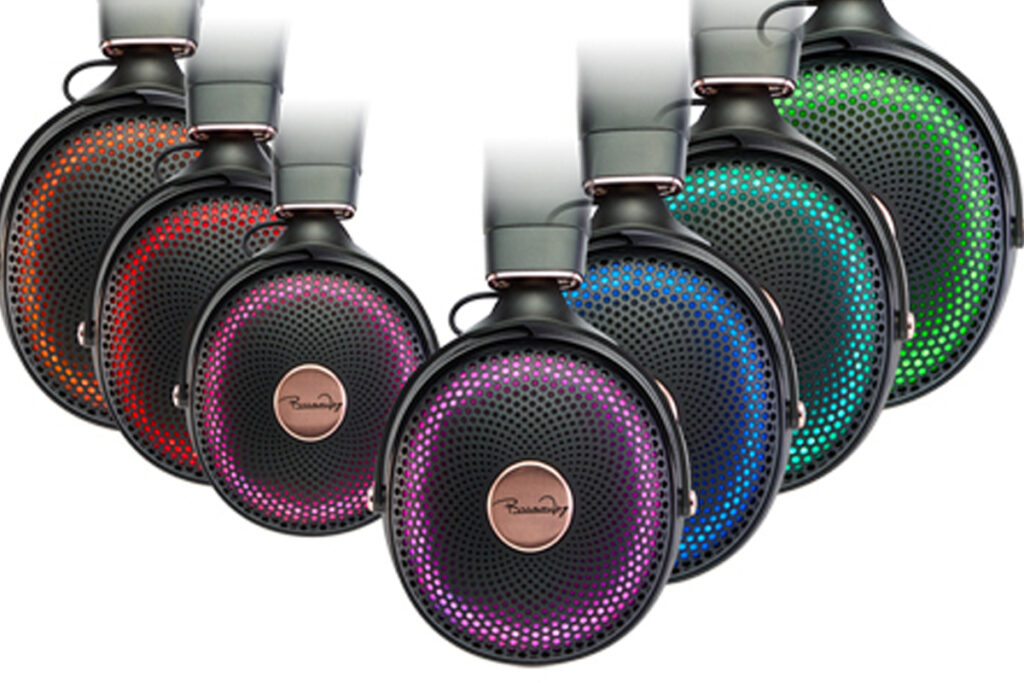
The earcups are visually striking: the mesh-style back covers are reminiscent of Audio-Technica’s ATH series, but they conceal an RGB LED ring that pulses in sync with the music—a truly eye-catching effect. While you can adjust the color and brightness, the flashy lighting does increase power consumption (battery life is 24 hours with RGB on, versus 40 hours with it off).
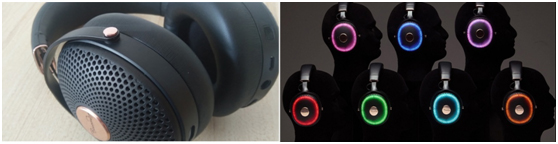
The Poly50 weighs 320g and the Para50 weighs 290g; both are lightweight with moderate clamping force, making them suitable for extended listening sessions. I wore the Poly50 for three hours straight without feeling any significant pressure. While the comfort level might not be top-tier, it is outstanding for products in this price range.
Interpretation of Technical Specifications
| Poly50 | Para50 | |
| Wireless | 5.8GHz + Bluetooth 5.4 | Bluetooth 5.4 only |
| Latency | 5.6ms (5.8GHz mode) | ~40ms typical (Bluetooth) |
| Frequency Response | 15Hz – 20kHz | 15Hz – 20kHz |
| Dynamic Range | >106dB (A-weighted) | >106dB (A-weighted) |
| THD | <0.002% | <0.002% |
| Sensitivity | 102dB/mW | 102dB/mW |
| Battery Life | 40h (BT) / 10h (BT+5.8G) | 40h (BT) / 24h (BT+RGB) |
| Weight | 320g | 290g |
Both headsets utilize the same core driver unit: a 50mm dynamic driver with a rated impedance of 50Ω and a sensitivity of 102dB/mW. This means they can be easily driven by devices ranging from smartphones and laptops to audio interfaces.
However, the most impressive feature is the Total Harmonic Distortion (THD) of 0.002%. This indicates that the drivers introduce virtually no additional distortion to the signal, resulting in high audio fidelity. In contrast, many studio-grade headphones in the same price range typically exhibit THD levels between 0.1% and 0.5%.
The 106dB dynamic range (A-weighted) reflects the headset’s performance when handling the quietest and loudest passages of music. It possesses sufficient headroom to reproduce classical music or film soundtracks without compression distortion.
The Poly50’s transmitter offers another major advantage: it employs 5.8GHz wireless transmission technology, resulting in a latency of just 5.6 milliseconds—virtually imperceptible to the human ear. For comparison, standard Bluetooth connections using the SBC codec typically have a latency of 100–200 milliseconds, while even aptX Low Latency technology hovers around 40–60 milliseconds. A latency of 5.6 milliseconds means the Poly50 delivers near real-time response. You can play synthesizers, trigger drum pads, or monitor vocal recordings without encountering any annoying or unacceptable lag.
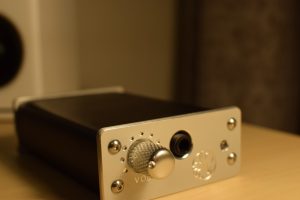
Regarding battery life, the transmitter’s built-in lithium battery supports approximately 4 hours of continuous use. Battery life for the headset itself varies depending on the usage mode:
• Bluetooth-only mode (lighting off): Approximately 40 hours—suitable for everyday wireless listening;
• Transmitter-powered mode (lighting off): Approximately 10 hours—suitable for playing musical instruments;
• With lighting enabled: Battery life is reduced accordingly.
Controls & Usability: Functional, But Not Effortless
The controls cover all essential functions: power, volume, track skipping, play/pause, and RGB lighting modes. The headset also features a built-in microphone for calls and voice assistant commands.
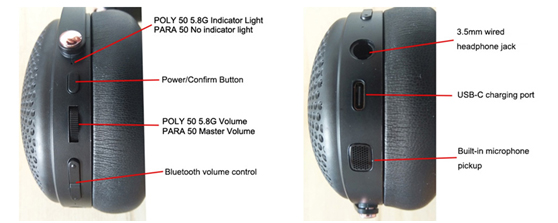
The downside is the number of buttons, which makes operation by feel—without looking—prone to error. You have to memorize the button layout or take off the headset to adjust settings. While not a deal-breaker, this serves as a reminder that the device functions more like a utilitarian tool than a highly polished consumer product.
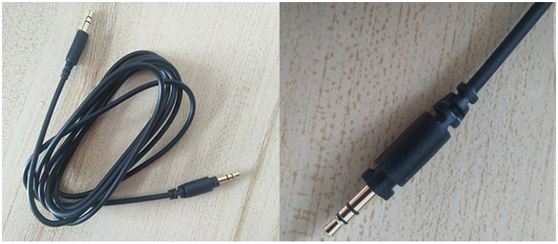
Additionally, the headset comes with a 3.5mm cable featuring a locking connector; this is highly practical for professional use, as it effectively prevents accidental disconnection. If the transmitter runs out of battery during a performance, you can simply plug in the cable and keep playing.
Actual Listening Performance
● Tri-band performance
The high-frequency range (5kHz–20kHz) excels, clearly reproducing instrumental overtones and high-frequency details while ensuring brightness and a sense of airiness.
The mid-frequency range (300Hz–5kHz) is accurate and natural, offering high fidelity in the reproduction of vocals and instruments. Sound density is well-balanced—neither thin nor overly heavy.
The low-frequency range (20Hz–300Hz) effectively reproduces low-end detail and impact; it remains clear and punchy, free from muddiness or looseness.
● Analytical skills test, Song: ‘Fast Car’ — Tracy Chapman (1988)

This minimalist folk song is made up of acoustic guitar, steady bass, and light percussion. It’s this kind of ‘simplicity’ that makes it an excellent piece for testing resolution. There are no layers to hide the weaknesses of the sound units.
The sliding notes and finger movements on the opening guitar aren’t masked by the mix; they come through with a crisp, solid texture. You can hear the smooth tail of the slides and the ‘squeak’ of hands moving along the fretboard.
In the mix, the hi-hat almost quietly sits in the background, and a 50mm driver can bring it forward just enough so you can hear it clearly without it being jarring—subtle yet very present.
Chapman’s tone is neutral and slightly hoarse, with a real chest resonance. Good resolution brings out the details around the notes: breathing sounds and subtle changes in timbre. I can tell I’m hearing not just the melody, but also the singing technique.
● Soundstage and imaging test, track: ‘Hotel California’— Eagles

This live unplugged recording serves as a benchmark for testing soundstage performance. Rather than a stereo studio mix, it authentically captures the sound as picked up by stage microphones.
At the 39-second mark, the maracas and rhythm guitar enter from the left and right channels respectively, the separation between them is excellent, and the lateral width of the soundstage is impressive.
Regarding depth and layering, the congas are clearly positioned behind and slightly to the right of the lead vocalist, conveying a genuine sense of distance rather than merely a difference in volume.
Here, the 50mm dynamic drivers demonstrate exceptional spatial imaging capabilities; the soundstage is roughly elliptical—wider than it is deep—with precise instrument placement that rivals mid-to-high-end open-back headphones. Thanks to the excellent high-frequency extension, the audience’s applause and whistling do not blur into an indistinct “wall of noise” but instead retain a clear sense of directionality; the reverb decay is natural and restrained, devoid of any artificial embellishment. The only minor drawback is that the soundstage feels slightly lacking in vertical height.
● Dynamic range test, track: ‘Bohemian Rhapsody’ — Queen

In the operatic aria passage featuring layered vocals, the individual lines of each voice remain distinct even at *pianississimo* (PPP) levels.
A pivotal moment occurs with the sudden entry of a *fortississimo* (FFF) heavy metal section (roughly 4:07–4:56); the electric guitar power chords deliver a visceral, tearing quality, while the kick drum packs a full, impactful punch.
The 106 dB-A dynamic range translates into a tangible listening experience where the contrast between the quietest and loudest moments is fully preserved; the headphones show no signs of compression, maintaining ample headroom throughout.
In short: the dynamic range is expansive, transitions between soft and loud passages are crisp and clean, distortion is excellently controlled, and complex sections remain clearly articulated. However, due to limitations in the soundstage, the vertical layering of the mix lacks the distinctness found in top-tier flagship headphones—though, given the price point, perhaps one shouldn’t be too demanding in this regard.
● Transient response test, track: ‘Take Five’ — Dave Brubeck Quartet

The opening cymbal strikes possess a distinct metallic quality, with the subsequent decay of overtones being brief and natural—free of any lingering “hiss”—serving as clear evidence of clean transient response.
The snare drum responds rapidly; the crisp definition of the strike and the resonance of the wooden shell unfold sequentially within a split second, maintaining distinct layering.
The pizzicato of the double bass offers another point of observation: the tension of the plucked strings is faithfully reproduced, with deep low-frequency extension coupled with tight control—the lingering vibration cuts off precisely when it should, avoiding any low-frequency masking of the subsequent note.
In short: the transient response is swift and clean, with the attack and decay of percussion instruments expertly managed—a rare example of high-speed responsiveness in a dynamic driver.
● Testing the Poly50 transmitter (5.8GHz mode) using the KORG X3 synth as the sound source
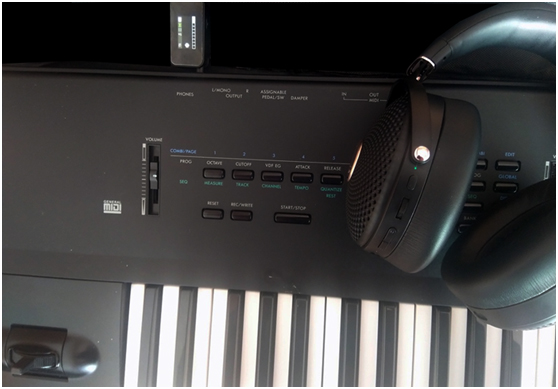
Switching from Bluetooth to 5.8GHz on the Poly50 really makes the headphones shine. You can immediately feel the drop in latency—it’s not just about timing, it’s a direct, tangible sensation. It’s like the notes are connected to your fingers, a feeling that even aptX Low Latency can’t match.
I tested fast arpeggios at 120 BPM on a synthesizer, and the notes landed exactly where I expected them to. There’s no gap between the metronome and the notes. For anyone who’s ever played music with a Bluetooth device, this is a total surprise.
The transmitter’s dynamic range (118dB) also means lower background noise. Using the Poly50 in 5.8GHz mode, the background is completely silent—no hissing, no digital fuzz.
Summing
The BrianFay Poly50 and Para50 are two headphones wearing the same clothes, but they’re built for completely different people.
The Para50 is a solid Bluetooth headset with excellent total harmonic distortion performance and relatively long battery life. Priced around $100, it can compete with mid-range models from Anker/Soundcore, Sony, and JBL. While it may not match these brands in comfort or brand recognition, its sound quality is on par with them and its distortion stats surpass most. If you’re looking for a reliable everyday wireless headset, the Para50 is a pretty good choice—though at this price, you’ve got plenty of well-established alternatives too.
The Poly50 is a completely different experience. For keyboardists, synth players, or any musician who needs wireless instrument monitoring with less than 5.6 ms latency, it solves the problem of tangled stage cables. In terms of “transmitter battery life” and “real-time control operation,” it’s not perfect. The build quality isn’t exactly award-winning either. But its wireless low-latency performance is comparable to wired headphones, and at around $160, it’s worth the money.
If you’re just casually listening to music, you might want to go with the Para50 to save some cash. But if you’re a performing musician tired of stepping on too many cables, the Poly50 is worth every penny.
Price:
Poly50: $161.55
Para50: $99.81
Manufacturer’s Website: http://www.brian-fay.com/h-col-105.html
Transmitter (Poly50 only):
Range: 20m (outdoor)
Latency: 5.6ms
Dynamic Range: >118dB (A-weighted)
THD: <0.002%
Battery Life: ~4 hours
Input: 6.35mm TS (instrument/line level)

Want to join discussion?
Feel free to contribute!